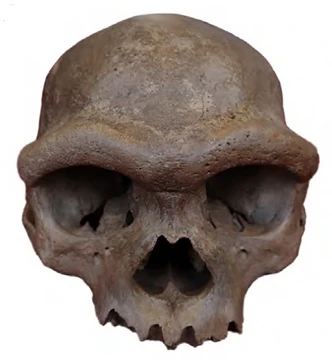
Ardi
4.4-million-year-old fossilized skeleton of an early human-like female anthropoid.

Ardi (ARA-VP-6/500) is the name given to the fossilized skeleton of an *Ardipithecus ramidus*, an early human-like female primate from about 4.4 million years ago. It is one of the most complete early hominin specimens known, consisting of 125 bone fragments that include much of the skull, teeth, pelvis, hands, and feet.
A graduate student named Yohannes Haile-Selassie found a partial hand bone at Aramis, in the dry badlands near Ethiopia’s Awash River, in 1994. The excavation was led by UC Berkeley anthropologist Tim White, and an international team—with Claude Lovejoy heading the biology group—analyzed the remains. On 1 October 2009, the journal *Science* published a collection of eleven articles detailing *Ardipithecus ramidus* and its habitat (though the articles were not open-access, as *Science* typically requires a subscription). Animal fossils found nearby suggested Ardi lived in a forested environment, challenging the idea that bipedalism first evolved in savannahs. Earlier *Ardipithecus ramidus* fossils had been found in Ethiopia in 1992, but it took 17 years to understand their importance.
In the Afar language, “Ardi” means “ground floor,” while “ramidus” is the Latinized species name derived from “ramus,” meaning branch, implying that Ardi lived on the ground and represents a branch of the human family tree.
Ardi weighed about 50 kg (110 lb) and stood roughly 1.2 m (3.9 ft) tall. Though she was bipedal, she had opposable big toes and thumbs for climbing trees. Her bipedalism may have limited movement but allowed her to bear more offspring. It remains unclear exactly how her species relates to humans, but the find significantly fueled debate about *Ardipithecus* and human evolution. Ardi’s body combines traits seen in both extinct primates and early hominids. Whether she was truly bipedal is still debated: her divergent big toes are not typical of a biped, but her legs, feet, pelvis, and hands suggest she walked upright on the ground and moved on all fours in trees. Her big toe spread widely for grasping branches, and her foot anatomy is more accurately described as having a grasping big toe for climbing, rather than a rigid foot adapted for upright walking. Her wrist bones were flexible, but her palm bones were short, indicating she did not knuckle-walk and used only her palms to move along branches.
Some teeth remain attached to he
- known_for
- One of the most complete early hominin specimens; 125 pieces including skull, teeth, pelvis, hands, and feet
Lore & Background
The Ardi skeleton was discovered at Aramis in the arid badlands near the Awash River in Ethiopia in 1994 by graduate student Yohannes Haile-Selassie, when he uncovered a partial piece of a hand bone. The discovery was made by a team of scientists led by UC Berkeley anthropologist Tim White, and was analyzed by an international group of scientists that included Claude Lovejoy heading the biology team. On 1 October 2009, the journal Science published a collection of eleven articles (not open-access, as Science typically requires a subscription), detailing many aspects of Ardipithecus ramidus and its environment. Her fossils were also found near animal remains which indicated that she inhabited a forest type of environment, contrary to the theory that bipedalism originated in sav
Reader's Guide
Ardi's significance lies in her unique combination of traits characteristic of both extinct primates and early hominids, providing a snapshot of early bipedalism around 4.4 million years ago. Although it is not yet clear how Ardi's species is related to humans, her pelvis shows a shorter ilium and a curve in the lower spine that indicate the ability to walk upright, while her opposable big toe and flexible wrist bones suggest she was also adapted for climbing trees. Her foot contains a bone called the os peroneum, which allowed the bottom of the foot to be more rigid, aiding bipedal walking, though less efficiently than later hominids like Lucy. The discovery of Ardi in a forest environment challenged the prevailing theory that bipedalism originated in savannahs. Her teeth show enamel wear suggesting a diet of fruit and nuts, and the small, equal-sized canine teeth in males and females suggest reduced male-to-male conflict, pair-bonding, and increased parental investment, indicating that fundamental reproductive and social behavioral changes occurred in hominids long before they had enlarged brains and began to use stone tools.
Did You Know?
- Ardi was discovered in 1994 by graduate student Yohannes Haile-Selassie.
- The word 'Ardi' means 'ground floor' in Afar; 'ramidus' is the Latinized species name derived from 'ramus' (branch), not an Afar word.
The Discovery and the Long Road to Recognition
In 1994, a college student named Yohannes Haile-Selassie was working in the arid badlands near the Awash River in Ethiopia when he pulled a small fragment of hand bone from the sediment at a site called Aramis. That modest find, made under the direction of UC Berkeley anthropologist Tim White, would eventually unlock one of the most important chapters in human evolutionary history. The broader research team included an international group of specialists, with Claude Lovejoy leading the biological analysis. What made the project remarkable was not only the fossil itself but the patience required to interpret it: the very first Ardipithecus ramidus specimens had surfaced in Ethiopia back in 1992, yet it took a full seventeen years before scientists could fully gauge their significance. The assembled skeleton, comprising roughly 125 fragments that included most of the skull, the teeth, the pelvis, both hands, and both feet, stood as the most complete early hominin specimen known until the full excavation of Little Foot. On October 1, 2009, the journal Science released an open-access collection of eleven papers that laid out the anatomy, ecology, and evolutionary context of this remarkable individual in unprecedented detail.
A Body Built for Two Worlds
Ardi's skeleton presents a striking mosaic of traits that belong to neither a modern ape nor a fully committed biped. Her big toe fans outward from the foot in a manner reminiscent of a chimpanzee's, clearly adapted for wrapping around tree branches. Yet buried within a tendon of that same foot lies the os peroneum, a small bone that stiffens the sole and allows the other four, neatly aligned toes to execute the push-off phase of an upright stride. Her pelvis tells a similar story of transition: the shortened ilium and the curvature of the lower spine point toward habitual upright walking, while the ischial structure echoes that of living African apes. A distinct growth site on the anterior inferior iliac spine is shared with every later hominid, marking Ardi as part of the same lineage. In the hands, the wrist bones granted considerable flexibility, but the short palm bones indicate she pressed her palms against branches rather than knuckle-walking. Together these features paint a creature that spent meaningful time on the ground yet retained a full arboreal toolkit, walking upright with less efficiency than the later, better-known Lucy.
Teeth, Bonding, and a New Social World
The dental remains of Ardi carry implications that reach far beyond diet. Enamel wear patterns on teeth still anchored to her jawbone point to a menu of fruits and nuts, but the more telling detail lies in the canines. In Ardipithecus ramidus, the canines are notably smaller than those of earlier primates, and crucially, they are roughly equal in size between males and females. In many ape species, enlarged male canines serve as weapons in aggressive encounters and as status signals; their reduction here suggests a fundamental shift in social dynamics. Researchers interpret this as evidence of diminished male-to-male combat, the emergence of pair-bonding, and a greater investment of parental care by both sexes. The broader conclusion drawn from the 2009 Science papers is striking: these reproductive and social transformations took hold in early hominids long before the lineage developed enlarged brains or began manufacturing stone tools. Even the very act of walking upright, while it may have slowed Ardi down in some contexts, appears to have altered her reproductive physiology in ways that allowed her to bear more offspring.
Redefining the Starting Line
For decades, the prevailing narrative placed the origin of bipedalism in open savannahs, where the loss of forest cover supposedly forced early hominids onto two legs. Ardi upended that story. Her fossils were recovered alongside the remains of animals that thrived in wooded habitats, indicating that she lived in a forested environment roughly 4.4 million years ago. In other words, the shift toward upright walking was already well underway while her world was still dominated by trees. The name itself, drawn from the Afar language, captures this idea: "ramid" means "root" and "Ardi" means "ground floor," evoking a creature at the very base of the human family tree, still rooted in the canopy. Standing about 1.2 meters tall and weighing roughly 50 kilograms, Ardi is a female whose exact relationship to later humans remains debated. Yet her unique blend of primate and hominid traits has made her a cornerstone of the ongoing conversation about where, when, and why our lineage first stepped away from the branches.
Frequently Asked Questions
What is Ardi?
Ardi is the nickname for a fossilized female primate skeleton classified as Ardipithecus ramidus, dating back roughly 4.4 million years. The specimen, cataloged as ARA-VP-6/500, represents one of the oldest and most intact early hominin bodies ever recovered.
Who discovered Ardi and where?
A graduate student named Yohannes Haile-Selassie first uncovered a partial hand bone at the Aramis site in Ethiopia's Awash River badlands in 1994. The full excavation was later directed by UC Berkeley anthropologist Tim White along with an international research team.
How complete is Ardi's skeleton?
The specimen comprises 125 bone fragments that preserve a substantial portion of the skull, teeth, pelvis, hands, and feet. This level of preservation is exceptionally rare for a primate this old and far exceeds what most other early hominin fossils offer.
What did Ardi's body reveal about how she moved?
The shape of her pelvis and foot bones indicates she walked upright on the ground, while her grasping hands and mobile thumbs suggest she still spent significant time climbing in trees. This combination points to a mixed locomotor lifestyle rather than full-time bipedalism.
Why is Ardi considered a landmark find in human evolution?
At 4.4 million years old, Ardi predates the famous 'Lucy' Australopithecus by over a million years, filling a critical gap in the early hominin record. The specimen's completeness allows researchers to study the full body plan of a creature living near the base of the human family tree.
Spotted an error? Know more?
This is a living reference — every entry is fact-audited, and reader corrections feed straight into our audit queue. Suggest an edit · See this site's audit record