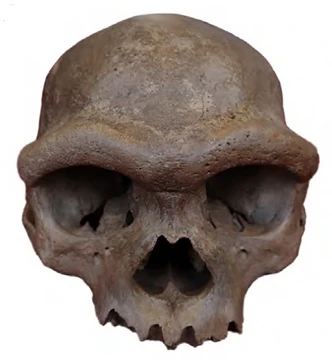
Ardipithecus ramidus
Early hominin with mixed bipedal and arboreal adaptations.
Ardipithecus ramidus is an early hominin species that lived in what is now the Afar region of Ethiopia around 4.4 million years ago, during the Early Pliocene. It is the defining species of the genus Ardipithecus. A more ancient species in the same genus, Ardipithecus kadabba, was discovered later.
Unlike modern hominids, A. ramidus shows features suited for both walking upright and living in trees. It had a divergent big toe, useful for climbing, alongside evidence of bipedality. This combination meant it was less efficient at walking on two legs than humans or later Australopithecus (which lacked a divergent big toe), and less adept at moving through trees than non-human great apes.
The discovery of Ardipithecus, along with Miocene apes, changed scientific views on the last common ancestor of chimpanzees and humans. Before this, researchers often thought humans evolved from a chimpanzee-like ancestor. Ardipithecus shows that this common ancestor did not closely resemble any living monkey or ape (such as chimpanzees, orangutans, or gorillas). Instead, it was an intermediate form—linking the later Australopithecus (and acting as a bridge to a yet-unknown late Miocene African ape) with both humans and modern chimpanzees in a more distant way.
Beyond its divergent big toe, A. ramidus had unusual dental features: its canines were reduced in size and showed little difference between males and females. This suggests that males were less aggressive than modern chimpanzees, a trait often linked in primates to greater parental care and monogamy.
A. ramidus appears to have lived in woodland and bushland corridors between savannas, and it was a generalist omnivore.
**Taxonomy**
The first fossils were described in 1994 by American anthropologist Tim D. White, Japanese paleoanthropologist Gen Suwa, and Ethiopian paleontologist Berhane Asfaw, as part of the Middle Awash Project, a collaboration with geologist Giday WoldeGabriel. The holotype, ARA-VP-6/1, consists of ten associated teeth, along with 16 other paratype specimens that included skull and arm fragments. These were found in 4.4-million-year-old deposits at Aramis, Ethiopia, from 1992 to 1993, making them the oldest hominin remains known at the time, older than Australopithecus afarensis. Initially classified as Australopithecus ramidus (the species name comes from the Afar word *ramid*, meaning "root"), t
- Species
- Ardipithecus ramidus
- Time period
- 4.4 million years ago (Early Pliocene)
- Location
- Afar region, Ethiopia
- Described by
- Tim D. White, Gen Suwa, Berhane Asfaw (1994)
- Known for
- Oldest hominin remains at time of discovery; adaptations for both bipedality and arboreality; reduced canine sexual dimorphism
Lore & Background
The first remains of Ardipithecus ramidus were described in 1994 by American anthropologist Tim D. White, Japanese paleoanthropologist Gen Suwa, and Ethiopian paleontologist Berhane Asfaw, as part of the Middle Awash Project. The holotype specimen, ARA-VP-6/1, comprised an associated set of 10 teeth, with 16 other paratypes preserving skull and arm fragments, unearthed from 1992 to 1993 in Aramis, Ethiopia. Initially classified as Australopithecus ramidus, the species was reclassified into the separate genus Ardipithecus in 1995. The most complete specimen is the 4.4-million-year-old female ARA-VP 6/500, known as 'Ardi'.
Reader's Guide
Ardipithecus ramidus is significant because its discovery, along with Miocene apes, reworked academic understanding of the chimpanzee–human last common ancestor. Historically, humans were thought to have evolved from a chimpanzee-like ancestor, but Ardipithecus demonstrates that the last common ancestor had no close analog among living monkeys or apes, representing an intermediate species between Australopithecus and both humans and modern chimpanzees. Its combination of a divergent big toe for climbing and evidence of bipedality indicates it was not as efficient at bipedality as humans or Australopithecus, nor as good at arboreality as non-human great apes. The reduced size and sexual dimorphism of its canines suggest that A. ramidus males were less aggressive than modern chimps, a feature correlated with increased parental care and monogamy. The species inhabited woodland and bushland corridors between savannas and was a generalized omnivore. Its discovery also challenged the assumption that bipedality originated due to a switch from forest to savanna, as pre-Australopithecus hominins lived in woodlands.
Did You Know?
- Ardipithecus ramidus had a divergent big toe adapted for climbing, unlike later hominins.
- The species name 'ramidus' comes from the Afar language word for 'root'.
- The most complete specimen, 'Ardi', was a female estimated to have stood 117–124 cm and weighed 51 kg.
- A. ramidus males and females had similar-sized upper canines, unlike modern chimpanzees.
More in Extinct Hominins 1-19
Spotted an error? Know more?
This is a living reference — every entry is fact-audited, and reader corrections feed straight into our audit queue. Suggest an edit · See this site's audit record