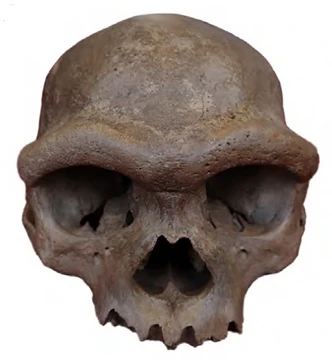
Australopithecus bahrelghazali
Central African australopithecine known from few jawbones.
Here is the rewritten encyclopedia entry:
Discovered in 1995 at Koro Toro in Chad’s Bahr el Gazel region, *Australopithecus bahrelghazali* is an extinct australopithecine that lived about 3.5 million years ago during the Pliocene. It is the only australopithecine ever found in Central Africa, proving that these early hominins ranged widely across the continent rather than being confined to East and southern Africa, as scientists once believed. However, its status as a distinct species remains controversial. Most researchers prefer to classify the few known remains—three partial jawbones and a single isolated premolar—as *Australopithecus afarensis*, a better-known Pliocene species from East Africa, because the fossils are anatomically very similar and the sample is so small.
- species
- Australopithecus bahrelghazali
- time_period
- Pliocene, around 3.5 million years ago
- discovery_year
- 1995
- discovery_location
- Koro Toro, Bahr el Gazel, Chad
- known_for
- First australopithecine from Central Africa; suggests wide distribution across Africa
Lore & Background
In 1995, two specimens were recovered from Koro Toro, Bahr el Gazel, Chad: KT12/H1 or 'Abel' (a jawbone preserving the premolars, canines, and the right second incisor) and KT12/H2 (an isolated first upper premolar). They were discovered by the Franco-Chadian Paleoanthropological Mission, and reported by French palaeontologist Michel Brunet, French geographer Alain Beauvilain, French anthropologist Yves Coppens, French palaeontologist Emile Heintz, Chadian geochemist engineer Aladji Hamit Elimi Ali Moutaye, and British palaeoanthropologist David Pilbeam. Based on the wildlife assemblage, the remains were roughly dated to the middle to late Pliocene 3.5–3 million years ago; consequently, the describers decided to preliminarily assign the remains to Australopithecus afarensis, which inhabited Ethiopia during that time period, barring more detailed anatomical comparisons. In 1996, they allocated it to a new species, A. bahrelghazali, naming it after the region; Bahr el Gazel means 'River of the Gazelles' in classical Arabic. They denoted KT12/H1 as the holotype and KT12/H2 a paratype. Another jawbone was discovered at the K13 site in 1997, and a third from the KT40 site.
Reader's Guide
Australopithecus bahrelghazali is significant as the first australopithecine recovered from Central Africa, disproving the earlier notion that they were restricted to east of the eastern branch of the East African Rift. Koro Toro is situated about 2,500 km from the Rift Valley, and the remains suggest australopithecines were widely distributed in grassland and woodland zones across the continent. The lack of other Central and West African australopithecines may be due to sampling bias, as similarly aged fossil-bearing sediments are more or less unknown beyond East Africa. The validity of A. bahrelghazali has not been widely accepted given how few remains there are and how similar they are to A. afarensis. Carbon isotope analysis has shown that A. bahrelghazali had high δ13C values, indicating a diet of predominantly C4 savanna foods, such as grasses, sedges, underground storage organs, or rhizomes, with a smaller C3 portion. However, the teeth seem ill-equipped to process C4 plants, so its true diet is unclear. The specimens inhabited a lakeside grassland environment with sparse tree cover, possibly similar to the modern Okavango Delta.
Did You Know?
- A. bahrelghazali is known only from 3 partial jawbones and an isolated premolar.
- The species name 'bahrelghazali' means 'River of the Gazelles' in classical Arabic.
- The holotype specimen KT12/H1 is nicknamed 'Abel'.
- The teeth of A. bahrelghazali seem ill-equipped to process C4 plants, despite isotopic evidence of a C4-rich diet.
More in Extinct Hominins 1-19
Spotted an error? Know more?
This is a living reference — every entry is fact-audited, and reader corrections feed straight into our audit queue. Suggest an edit · See this site's audit record