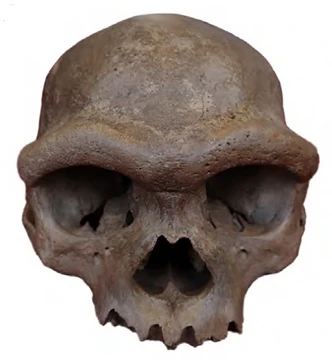
Ardipithecus
Extinct hominine genus from Ethiopia, debated as early human ancestor.
Ardipithecus is a genus of extinct hominines from Ethiopia's Afar Depression, living during the Late Miocene and Early Pliocene. It was initially thought to be one of the earliest human ancestors after the split from the last common ancestor with chimpanzees, but whether it belongs to the hominin lineage is now debated. Two species are known: *A. ramidus*, from about 4.4 million years ago in the early Pliocene, and *A. kadabba*, from roughly 5.6 million years ago in the late Miocene.
Early behavioral studies suggested Ardipithecus was very similar to chimpanzees, but more recent work, based on canine size and the lack of canine sexual dimorphism, indicates reduced aggression and a closer resemblance to bonobos. Some analyses place Australopithecus as a sister group to *A. ramidus* specifically, meaning Australopithecus is more closely related to that species than to *A. kadabba*. Cladistically, Australopithecus (and eventually *Homo sapiens*) emerged within the Ardipithecus lineage, so that lineage is not truly extinct.
*Ardipithecus ramidus* was named in September 1994. Its first fossil was dated to 4.4 million years ago by its position between two volcanic layers: the basal Gaala Tuff Complex and the Daam Aatu Basaltic Tuff. The name comes mostly from the Afar language—*Ardi* means "ground" or "floor," and *ramid* means "root"—with *pithecus* from the Greek for "ape." Like most hominids, but unlike all earlier recognized hominins, it had a grasping big toe for tree locomotion. It is unclear how many other skeletal features reflect adaptation to ground-based bipedalism. Like later hominins, it had reduced canine teeth and reduced canine sexual dimorphism.
In 1992–1993, a team led by Tim White found the first *A. ramidus* fossils—seventeen fragments including skull, mandible, teeth, and arm bones—in the Middle Awash river valley of Ethiopia's Afar Depression. More fragments were recovered in 1994, totaling 45% of the skeleton. The fossil was first described as a species of Australopithecus, but White and colleagues later published a note renaming it under the new genus Ardipithecus. Between 1999 and 2003, a multidisciplinary team led by Sileshi Semaw discovered bones and teeth of nine *A. ramidus* individuals at As Duma in the Gona area of Ethiopia's Afar Region, dated to between 4.35 and 4.45 million years old.
*A. ramidus* had a small brain of 300 to 3
- Genus
- Ardipithecus
- Species
- A. ramidus, A. kadabba
- Time period
- Late Miocene to Early Pliocene
- Location
- Afar Depression, Ethiopia
- Known for
- Early hominine fossils, debated relation to human ancestors
- Key fossil
- Ardi (A. ramidus skeleton, ~4.4 million years old)
Lore & Background
On October 1, 2009, paleontologists formally announced the discovery of the relatively complete A. ramidus fossil skeleton first unearthed in 1994. The fossil is the remains of a small-brained 50-kilogram female, nicknamed 'Ardi', and includes most of the skull and teeth, as well as the pelvis, hands, and feet. It was discovered in Ethiopia's harsh Afar desert at a site called Aramis in the Middle Awash region. Radiometric dating of the layers of volcanic ash encasing the deposits suggest that Ardi lived about 4.3 to 4.5 million years ago. This date, however, has been questioned by others. Fleagle and Kappelman suggest that the region in which Ardi was found is difficult to date radiometrically, and they argue that Ardi should be dated at 3.9 million years.
Reader's Guide
Ardipithecus is significant because it provides some of the earliest fossil evidence from the period after the human-chimpanzee lineage split, though its exact position in the human family tree is debated. The discovery of the relatively complete 'Ardi' skeleton shed light on a stage of human evolution about which little was known, more than a million years before Lucy. However, because the Ardi skeleton is no more than 200,000 years older than the earliest fossils of Australopithecus, and may in fact be younger than they are, some researchers doubt that it can represent a direct ancestor of Australopithecus. Some analyses describe Australopithecus as being sister to Ardipithecus ramidus specifically, meaning that Australopithecus is distinctly more closely related to Ardipithecus ramidus than Ardipithecus kadabba. Cladistically, then, Australopithecus (and eventually Homo sapiens) indeed emerged within the Ardipithecus lineage, and this lineage is not literally extinct. The reduced canine size and lack of canine sexual dimorphism in Ardipithecus suggests reduced aggression and social patterns more similar to bonobos than to common chimpanzees, challenging the use of chimpanzees as a behavioral model for the ancestral hominid condition. Due to several shared characteristics with chimpanzees, its closeness to ape divergence period, and due to its fossil incompleteness, the exact position of Ardipithecus in the fossil record remains a subject of controversy.
Did You Know?
- Ardipithecus ramidus had a small brain measuring between 300 and 350 cm³, slightly smaller than a modern bonobo or chimpanzee brain.
- The name Ardipithecus ramidus stems from the Afar language: 'Ardi' means 'ground/floor' and 'ramid' means 'root'.
- The fossil 'Ardi' is the remains of a small-brained 50-kilogram female, discovered in 1994 and announced in 2009.
- Ardipithecus kadabba is known only from teeth and bits and pieces of skeletal bones, dated to approximately 5.6 million years ago.
More in Extinct Hominins 1-19
Spotted an error? Know more?
This is a living reference — every entry is fact-audited, and reader corrections feed straight into our audit queue. Suggest an edit · See this site's audit record