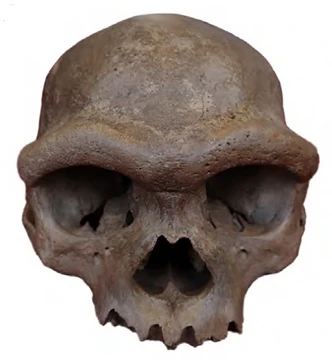
Australopithecus anamensis
Oldest known Australopithecus species, lived 4.3–3.8 million years ago.
Australopithecus anamensis is the earliest known species in the *Australopithecus* genus, living between about 4.3 and 3.8 million years ago. Over 90 fossil specimens, representing more than 20 individuals, have been found in Kenya and Ethiopia. The first fossils were discovered in Kanapoi and Allia Bay in northern Kenya, dated to around 3.8 to 4.2 million years ago. A single upper cranial fossil suggests a cranial capacity of roughly 365–370 cm³, smaller than that of *A. afarensis*.
The species is often considered a possible ancestor of *A. afarensis*, but the two may have coexisted for some time. Whether the lineage leading to modern humans emerged directly from *A. anamensis* or through *A. afarensis* is not settled. Some researchers treat *A. anamensis* and *A. afarensis* as a single evolving group, though a 2019 skull discovery (MRD-VP-1/1) suggests they overlapped, complicating the idea of a simple ancestor–descendant relationship.
**Discovery**
The first fossil of this species—a humerus fragment—was found in 1965 in the Kanapoi region of West Lake Turkana by a Harvard University team. Bryan Patterson and William W. Howells published their initial analysis in *Science* in 1967, estimating the bone to be about 2.5 million years old and identifying it as *Australopithecus*. Later, faunal correlation data revised the age to 4.0–4.5 million years.
In 1994, Meave Leakey and Alan Walker excavated the Allia Bay site, uncovering several hominid fragments, including a complete lower jaw. The jaw resembled that of a chimpanzee in shape, but its teeth were more human-like. Based on limited postcranial evidence, *A. anamensis* appears to have been habitually bipedal, though it retained primitive upper-limb features. In 1995, Leakey and her team assigned the finds to a new species, naming it *A. anamensis* after the Turkana word *anam*, meaning "lake." Leakey believes the species often climbed trees, a behavior retained by early hominins until the appearance of *Homo* about 2.5 million years ago.
Fossils from the 2000s, found between layers of volcanic ash dated to 4.17 and 4.12 million years ago, coincide with the first appearance of *A. afarensis* in the record. The 21 fossils from these sites include upper and lower jaws, cranial fragments, and parts of a leg bone (tibia). The 1965 humerus fragment was later reassigned to this species.
In 2006, a discovery
- lived
- roughly 4.3 to 3.8 million years ago
- field
- Paleoanthropology
- region
- Kenya and Ethiopia
- known_for
- Oldest known Australopithecus species; possible ancestor of A. afarensis
Lore & Background
The first fossilized specimen of the species, a fragment of humerus, was found in 1965 in the Kanapoi region of West Lake Turkana by a Harvard University research team. In 1994, Meave Leakey and Alan Walker excavated the Allia Bay site and uncovered several additional fragments, including a complete lower jaw bone. In 1995, Meave Leakey and her associates assigned the finds to a new species, A. anamensis, named from the Turkana word anam, meaning 'lake'.
Reader's Guide
Australopithecus anamensis is the earliest hominin species in the Turkana Basin and provides crucial evidence for early hominin evolution. Its fossils, including a nearly intact skull (MRD-VP-1/1) discovered in 2016 and announced in 2019, suggest that A. anamensis and A. afarensis lived side-by-side for at least 100,000 years, challenging the idea of a simple linear descent. The species was habitually bipedal but retained primitive upper limb features, and its diet, based on dental microwear and isotope evidence, consisted primarily of C3 resources with some C4-derived resources. The discovery of A. anamensis fills a gap in the hominin fossil record and raises questions about the evolutionary relationships among early Australopithecus species.
Did You Know?
- The first fossil of A. anamensis, a humerus fragment, was found in 1965 but not recognized as the species until later.
- The species name 'anamensis' comes from the Turkana word 'anam', meaning 'lake'.
- A nearly intact skull (MRD-VP-1/1) of A. anamensis was found by Afar herder Ali Bereino in 2016.
- A. anamensis and A. afarensis appear to have lived side-by-side for at least 100,000 years.
More in Extinct Hominins 1-19
Spotted an error? Know more?
This is a living reference — every entry is fact-audited, and reader corrections feed straight into our audit queue. Suggest an edit · See this site's audit record