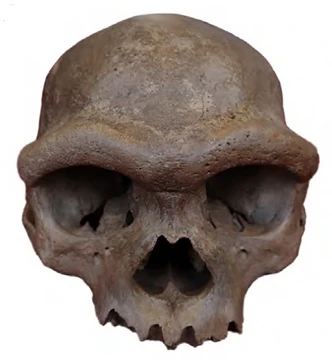
Australopithecus africanus
Early hominin from South Africa; first evidence of human evolution in Africa.
Here is the rewritten encyclopedia entry:
**Australopithecus africanus** is a now-extinct species of early hominin that existed in South Africa from roughly 3.3 to 2.1 million years ago, spanning the Late Pliocene and Early Pleistocene. Its fossils have been unearthed at the sites of Taung, Sterkfontein, Makapansgat, and Gladysvale. The first specimen discovered was the Taung child, which anatomist Raymond Dart described in 1924, making it the earliest known early hominin ever found. However, the idea that this species was more closely related to humans than to other apes did not gain widespread acceptance until the middle of the 20th century, largely because most scientists at the time believed human evolution had occurred outside of Africa.
How *A. africanus* fits into the hominin family tree remains unclear. It has been variously proposed as the ancestor of both *Homo* and *Paranthropus*, as ancestral only to *Paranthropus*, or as a direct ancestor of just *Paranthropus robustus*. The oldest known South African australopith, a remarkably complete skeleton nicknamed "Little Foot" (about 90% intact), has been controversially assigned to *A. africanus*, to its probable junior synonym *A. prometheus*, or to neither group.
The brain volume of *A. africanus* ranged from about 420 to 510 cc. Like other early hominins, its cheek teeth were enlarged and covered with thick enamel. Male skulls may have been more robust than those of females. Estimated average height and weight for males was 140 cm and 40 kg, while females averaged 125 cm and 30 kg. This species was a capable biped, though less efficient at walking than modern humans. It also retained several upper-body traits similar to those of arboreal, non-human apes. These features are interpreted either as evidence of a partially or fully tree-dwelling lifestyle, or as non-functional leftovers from a more ape-like ancestor. Notably, the upper body of *A. africanus* is more apelike than that of the East African species *A. afarensis*.
Unlike most other primates, *A. africanus* appears to have exploited C4 foods—such as grasses, seeds, rhizomes, underground storage organs, or possibly animals higher up the food chain. Still, its diet was highly variable, marking it as a generalist. In leaner times, it may have relied on harder, lower-quality foods like nuts. To survive such periods, children may have needed t
- lived
- 3.3 to 2.1 million years ago
- field
- Paleoanthropology
- region
- South Africa
- known_for
- First early hominin discovered; Taung child; evidence of human evolution in Africa
- brain_volume
- 420–510 cc
- height_male
- ~140 cm
- height_female
- ~125 cm
Lore & Background
The first specimen, the Taung child, was described by anatomist Raymond Dart in 1924 after he received fossil boxes from a limestone quarry in Taung, South Africa. Dart recognized it as a transitional fossil between apes and humans due to its small brain but bipedal posture, and named the new genus and species Australopithecus africanus. However, most scientists at the time believed humans evolved outside Africa, and the specimen was widely dismissed as a gorilla or chimpanzee ancestor, partly due to the Piltdown Man hoax and the discovery of Peking Man in China.
Reader's Guide
Australopithecus africanus is significant as the first early hominin discovered and the first fossil evidence supporting Charles Darwin's hypothesis that humans evolved in Africa. Its discovery challenged the prevailing view that large brains evolved before bipedalism, and its eventual acceptance helped overturn the Piltdown Man hoax. The species shows a mix of humanlike bipedalism and apelike upper body traits, indicating a partially arboreal lifestyle. Its diet was variable, including C4 foods like grasses and seeds, and it likely used hard foods like nuts in lean times. The species probably went extinct due to climatic variability and competition with Homo and Paranthropus robustus. The nearly complete skeleton 'Little Foot' has been controversially assigned to A. africanus or its possible synonym A. prometheus.
Did You Know?
- The Taung child was killed by a bird of prey.
- A. africanus brain volume was about 420–510 cc.
- Males averaged about 140 cm in height and 40 kg; females about 125 cm and 30 kg.
- The species exploited C4 foods such as grasses, seeds, and underground storage organs.
More in Extinct Hominins 1-19
Spotted an error? Know more?
This is a living reference — every entry is fact-audited, and reader corrections feed straight into our audit queue. Suggest an edit · See this site's audit record