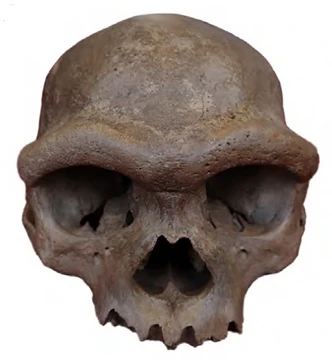
Australopithecus garhi
Early hominin possibly linked to the first stone tool industries.
Australopithecus garhi is a species of australopithecine from the Bouri Formation in the Afar Region of Ethiopia, dating to 2.6–2.5 million years ago during the Early Pleistocene. First described in 1999 based on remains uncovered in the preceding three years, it was originally considered a direct ancestor to Homo but is now thought to have been an offshoot. A. garhi is notable as the first pre-Homo hominin postulated to have manufactured stone tools for butchering, challenging the earlier belief that tool-making was unique to the genus Homo.
- species
- Australopithecus garhi
- time_period
- 2.6–2.5 million years ago
- region
- Afar Region, Ethiopia
- discovery_year
- 1999
- brain_volume
- 450 cc
- height
- about 140 cm (4 ft 7 in) for one presumed female
- known_for
- First pre-Homo hominin postulated to have manufactured stone tools
Lore & Background
The first remains of A. garhi were discovered in the Hatayae Beds of the Bouri Formation beginning in 1990, but the first identifiable Australopithecus fossils—an adult ulna—were found on 17 November 1996 by T. Assebework. A partial skeleton was discovered 13 days later by Tim D. White, and the holotype skull was found on 20 November 1997 by Yohannes Haile-Selassie. Additional specimens were recovered in the following days by Alban Defleur and David DeGusta. The species name garhi means 'surprise' in the local Afar language, reflecting the unexpected characteristics for a human ancestor at that time.
Like other australopithecines, A. garhi had a brain volume of about 450 cc, a prognathic jaw, and large molars and premolars. Its limb proportions—a humanlike humerus-to-femur ratio and an apelike brachial index—suggest adaptations for both bipedalism and climbing. One individual, presumed female, may have been about 140 cm tall. The species may have exhibited sexual dimorphism, though this is unclear due to the small sample size. A. garhi is associated with cut and percussion marks on animal bones, indicating stone tool use in butchering, though no tools were found at the site.
Reader's Guide
Australopithecus garhi occupies a key position in the study of human evolution because it is the first pre-Homo hominin postulated to have manufactured stone tools, specifically possibly the Oldowan industry previously attributed to Homo habilis. This challenges the long-held view that tool-making was a defining trait of the genus Homo. However, the discovery of Homo remains dating to 2.8 million years ago—older than A. garhi—complicates the picture, and the tools may instead have been produced by contemporary Homo. The species also provides insight into the anatomy and behavior of australopithecines during a poorly understood period between 3 and 2 million years ago. Its elongated legs, unusual among Australopithecus, may indicate a different growth pattern. Ultimately, A. garhi is now considered an offshoot rather than a direct ancestor of humans, but its association with early stone tool use remains significant.
Did You Know?
- The species name garhi means 'surprise' in the local Afar language.
- A. garhi is the first pre-Homo hominin postulated to have manufactured stone tools for butchering.
- One presumed female individual may have been about 140 cm (4 ft 7 in) tall.
- The holotype skull was discovered on 20 November 1997 by Ethiopian palaeoanthropologist Yohannes Haile-Selassie.
More in Extinct Hominins 1-19
Spotted an error? Know more?
This is a living reference — every entry is fact-audited, and reader corrections feed straight into our audit queue. Suggest an edit · See this site's audit record