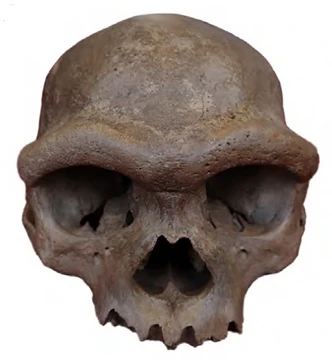
Australopithecus deyiremeda
A possible early hominin species known from fragmentary jaws.
Here is the rewritten encyclopedia entry:
Australopithecus deyiremeda is an extinct australopithecine species known only from three partial jawbones found in the Woranso–Mille area of Ethiopia’s Afar Region, dating to between 3.5 and 3.3 million years ago in the Pliocene. Because so little material exists, it is uncertain whether these fossils truly belong to a distinct species or are simply part of the variation seen in the much better-known *A. afarensis*. What sets *A. deyiremeda* apart from other early hominins are its forward-facing cheekbones and unusually small cheek teeth. A partial foot bone found nearby, which has a grasping big toe unlike any other australopithecine, may or may not belong to this species. The environment was a mosaic of open grasslands and forests near lakes or rivers. Anthropologist Fred Spoor has suggested that *A. deyiremeda* might have been involved in the Lomekwi stone-tool industry in Kenya, which is usually linked to *Kenyanthropus*. This species lived alongside *A. afarensis*, and the two may have avoided direct competition by relying on different fallback foods during lean seasons—a pattern known as niche partitioning.
**Taxonomy** The species was first proposed in 2015 by Ethiopian paleoanthropologist Yohannes Haile-Selassie and colleagues, based on jaw fossils from the Burtele and Waytaleyta areas of Woranso–Mille. The holotype—a young adult left upper jaw (maxilla) with all teeth except the first incisor and third molar—was found on March 4, 2011, by local resident Mohammed Barao. Two paratypes were also recovered: a complete adult lower jaw (mandible) with all incisors, and an adult right jawbone with no teeth. These were discovered by Ethiopian fossil hunter Ato Alemayehu Asfaw. A fragment of a right maxilla with a fourth premolar was found 5 meters east of the complete mandible, but it is unclear if they came from the same individual. The sediments were radiometrically dated to 3.5–3.3 million years ago, in the Middle Pliocene.
The describers argued that the remains were distinct enough from the contemporary *A. afarensis* to warrant a new species, adding to a growing list of Late Pliocene australopithecines that also includes *A. afarensis*, *A. bahrelghazali*, and *Kenyanthropus platyops*. The name *deyiremeda* comes from the Afar language and means "close relative," because the discoverers believed this earl
- Species
- Australopithecus deyiremeda
- Time period
- 3.5–3.3 million years ago (Middle Pliocene)
- Location
- Woranso–Mille, Afar Region, Ethiopia
- Described by
- Yohannes Haile-Selassie and colleagues (2015)
- Known from
- Three partial jawbones (holotype BRT-VP-3/1, paratypes BRT-VP-3/14 and WYT-VP-2/10)
- Key features
- Forward-facing cheek bones, small cheek teeth, robust jaw
Lore & Background
A. deyiremeda lived in a mosaic environment featuring both open grasslands and lake- or riverside forests, based on associated fauna such as grazing impalas, browsing giraffes, and forest-dwelling monkeys. It coexisted with A. afarensis, and they may have exhibited niche partitioning, relying on different fallback foods during leaner times. Anthropologist Fred Spoor suggested that A. deyiremeda may have been involved in the Kenyan Lomekwi stone-tool industry, typically assigned to Kenyanthropus.
Reader's Guide
Australopithecus deyiremeda is significant primarily for the questions it raises about early hominin diversity and classification. Its fragmentary remains—only three jawbones—make it difficult to determine whether it is a valid species or simply part of the variation within A. afarensis. If valid, it would indicate that multiple australopithecine species coexisted in the same region, potentially exploiting different ecological niches to avoid competition. The possible assignment of a dextrous-footed specimen to A. deyiremeda suggests a more primitive locomotor capability than that of A. afarensis, hinting at greater diversity in early hominin adaptation. Its potential link to the Lomekwi stone-tool industry, if confirmed, would extend tool-making behavior to a species other than Kenyanthropus. Overall, A. deyiremeda underscores the complexity of the hominin fossil record and the challenges of interpreting limited material.
Did You Know?
- The name 'deyiremeda' means 'close relative' in the Afar language.
- The holotype specimen was discovered on 4 March 2011 by local resident Mohammed Barao.
- A partial foot specimen with a dextrous big toe, BRT-VP-2/73, may belong to A. deyiremeda.
- Anthropologist Fred Spoor suggested A. deyiremeda may have been involved in the Lomekwi stone-tool industry.
More in Extinct Hominins 1-19
Spotted an error? Know more?
This is a living reference — every entry is fact-audited, and reader corrections feed straight into our audit queue. Suggest an edit · See this site's audit record