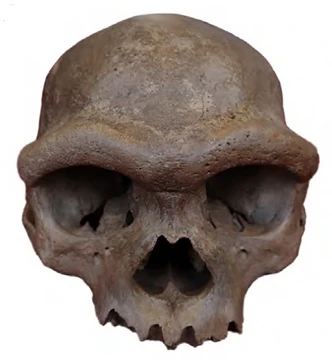
Australopithecus
Extinct early hominins ancestral to humans and other genera.
Australopithecus is an extinct genus of early hominins that existed in Africa during the Pliocene and Early Pleistocene. The genera Homo (which includes modern humans), Paranthropus, and Kenyanthropus evolved from some Australopithecus species, making the genus a key part of human evolutionary history.
- Earliest known member
- A. anamensis, around 4.2 million years ago
- Extinction
- 1.9 million years ago (or 1.2 to 0.6 million years ago if Paranthropus is included)
- Brain size
- Roughly 35% of modern human brain, average endocranial volume 466 cc
- Height
- 1.2 to 1.4 m (3 ft 11 in to 4 ft 7 in)
- Key species
- A. garhi, A. africanus, A. sediba, A. afarensis, A. anamensis, A. bahrelghazali, A. deyiremeda
- First discovery
- 1924, Taung, South Africa, by Raymond Dart
Lore & Background
The first Australopithecus specimen was discovered in 1924 in a lime quarry at Taung, South Africa, and studied by Australian anatomist Raymond Dart. The fossil skull, from a three-year-old bipedal primate nicknamed Taung Child, was named Australopithecus africanus. Dart concluded it was an early human ancestor, though anthropologists were initially hostile to this idea. Later, Scottish paleontologist Robert Broom and Dart searched for more specimens, and several more A. africanus remains were found. Acceptance grew after the late 1940s.
In 1950, evolutionary biologist Ernst Walter Mayr proposed classifying all bipedal apes into Homo, but J.T. Robinson's 1954 view excluding australopiths from Homo became prevalent. The first eastern African australopithecine fossil was an A. boisei skull excavated by Mary Leakey in 1959 at Olduvai Gorge, Tanzania. In 1997, an almost complete Australopithecus skeleton called 'Little Foot' was found in Sterkfontein caves, South Africa, around 3.7 million years old. In 2008, A. sediba was discovered in the same cave, living 1.9 million years ago.
Debate exists over whether some Australopithecus species should be reclassified into new genera, or if Paranthropus and Kenyanthropus are synonymous with Australopithecus. Because A. africanus is more closely related to humans than other Australopithecus branches, the genus cannot be consolidated without including Homo and other genera. A 2025 study reported preliminary success in extracting ancient proteins from an Australopithecus tooth.
Reader's Guide
Australopithecus holds central significance in human evolution as the genus from which Homo, Paranthropus, and Kenyanthropus evolved. Its fossils, found across eastern and southern Africa, document the transition from ape-like ancestors to bipedal hominins. The earliest known member, A. anamensis, lived around 4.2 million years ago, and the genus persisted until 1.9 million years ago. Australopithecus possessed two duplicated genes derived from SRGAP2, which contributed to neuron development in the human brain. Significant hand changes appear in later A. afarensis about 3 million years ago. The genus shows a mix of ape and human traits: brains about 35% the size of modern humans, small stature (1.2–1.4 m), and possible sexual dimorphism with males up to 50% larger than females. The Laetoli footprints (3.6 million years ago) provide early evidence of bipedalism. Taxonomic debates continue, with some scientists proposing reclassification of species into new genera or merging Paranthropus and Kenyanthropus into Australopithecus. Despite extinction, living descendants include the genus Homo.
Did You Know?
- The first Australopithecus specimen, the Taung Child, was discovered in 1924 in South Africa and studied by Raymond Dart.
- Australopithecus possessed two of the three duplicated genes derived from SRGAP2, which contributed to neuron development in the human brain.
- The earliest known member, A. anamensis, existed in eastern Africa around 4.2 million years ago.
- A 2025 study reported preliminary success in extracting ancient proteins from an Australopithecus tooth.
More in Extinct Hominins 1-19
Spotted an error? Know more?
This is a living reference — every entry is fact-audited, and reader corrections feed straight into our audit queue. Suggest an edit · See this site's audit record